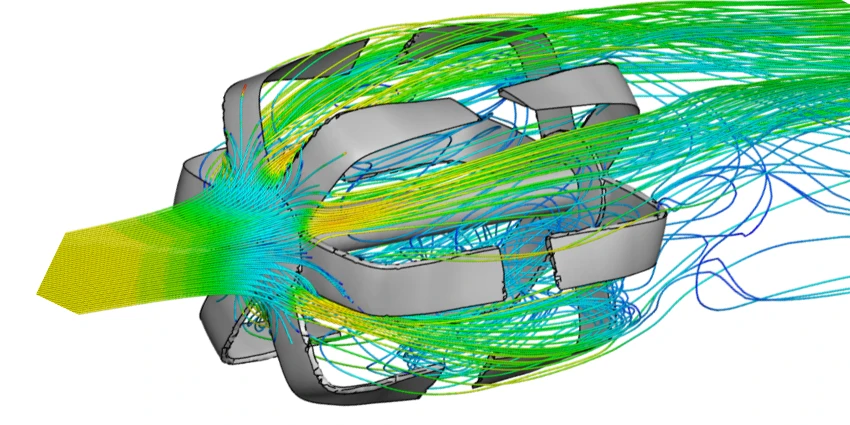
Fluid mechanics is a field of engineering that studies how fluids such as water, air, and gas move and react to forces. It plays an important role in many systems like engines, air conditioning units, aircraft, and power plants. Because fluid flow is often complex, traditional methods like hand calculations and physical testing can be slow, costly, and sometimes limited in accuracy.
To solve these challenges, engineers use Computational Fluid Dynamics (CFD) software. This computer-based tool helps predict how fluids will behave in different situations by solving the governing equations of fluid motion using numerical methods and algorithms. It allows engineers to simulate airflow, heat transfer, turbulence, and pressure changes within a virtual environment. As a result, engineers can test and optimize designs before building real products, making the development process faster, more cost-effective, and more efficient.
What is Computational Fluid Dynamics?
Computational Fluid Dynamics (CFD) is a method used to study how fluids move using computer simulations. It is based on mathematical equations that describe fluid motion, such as pressure, velocity, temperature, and density. These equations are solved using powerful computers to show how fluids behave in real-world conditions.
CFD software has become very important in engineering because it helps predict performance early in the design stage. Instead of building physical models, engineers can run simulations to see how a design will work and make changes before production starts.
How CFD Works in Simple Terms
CFD works by breaking a complex fluid problem into smaller parts so a computer can solve it step by step. It follows a clear process:
- A shape or object is created (like a car or pipe).
- The shape is divided into small sections called a mesh.
- Physical conditions like speed, pressure, and temperature are added.
- The computer solves fluid equations for each small section.
- The results are displayed in graphs, images, or color maps.
This process helps engineers clearly understand how fluids move around or inside objects.
1. Understanding CFD and How It Works
Steps in a CFD Simulation
1. Geometry creation
The process begins by creating the shape of the object being studied. This could be anything from a pipe to a vehicle or machine part. The shape is placed in a virtual space where the fluid will flow.
2. Mesh generation
The geometry is divided into small cells called a mesh. These cells help the computer calculate fluid movement in detail. A finer mesh gives more accurate results but requires more computing power.
3. Model setup
Engineers set the conditions of the simulation. This includes flow type, pressure, temperature, and whether the flow changes over time or stays steady.
4. Solution stage
The computer solves the fluid equations step by step. It repeats calculations until the results become stable and accurate.
5. Post-processing
The final results are shown in visual forms like charts and color maps. This makes it easier to understand flow patterns and improve designs.
2. Uses and Future of CFD
Why Engineers Rely on CFD
Engineers use CFD because it saves time, reduces cost, and improves design quality. It helps them test ideas quickly without building real prototypes.
CFD is used in many industries such as:
- Automotive design
- Aerospace engineering
- Energy systems
- Electronics cooling
It helps improve performance, safety, and efficiency in all these areas.
Future of CFD Technology
The future of CFD is moving toward more advanced and complete simulation systems. It will combine with other fields like heat transfer, solid mechanics, and chemical reactions. This will allow engineers to study full systems, not just fluid flow alone.
New technologies like artificial intelligence will also help CFD become faster and more accurate. As computers become more powerful, simulations will become more detailed and closer to real-life behavior.
Conclusion
Computational fluid dynamics has changed how engineers design and test products. It allows them to study fluid flow on a computer before building anything in real life. This reduces cost, saves time, and improves performance.
As technology continues to improve, CFD will become even more important in engineering and will help create better and more efficient designs in the future.